
Apprentice, Partner, Mentor, Monk
Or The Archetypical Forms of Duty

This essay will build upon past themes, how we all battle a Three Body Problem of the Mind between the fundamental desires that vie for our attention: duty, individuation, and hedonism.
In our last installment of this series, we dove into individuation and how it has two different archetypical paths. We defined the archetypical paths to individuation in The Cathedral Builder and The Renaissance Man Part 1 and discussed their pitfalls in Part 2.
We will build upon this series here by zooming in on duty. Note that reading these past essays is not pre-requisites for this one.
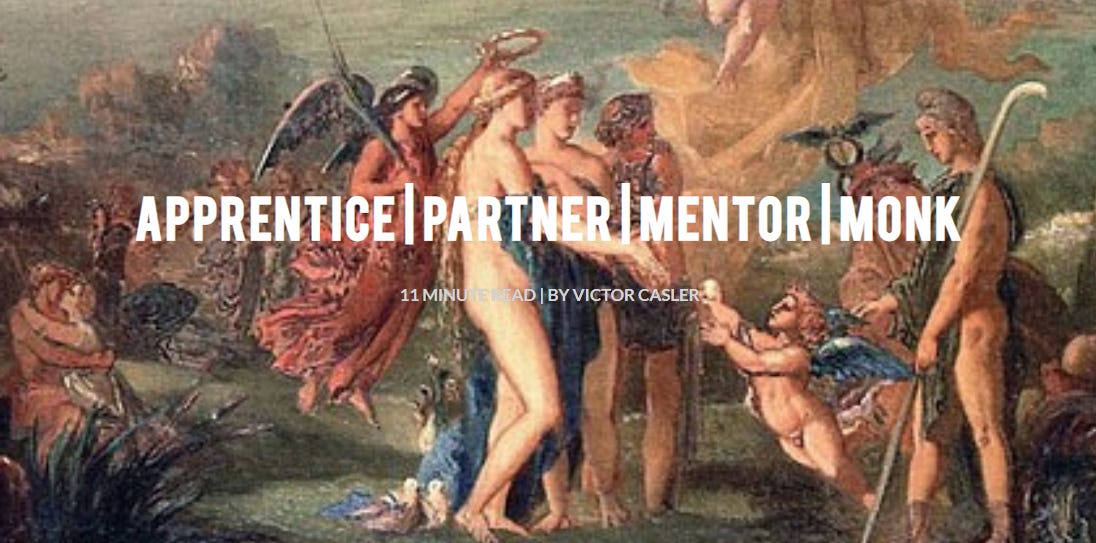
The force of duty could be visualized as an angel sitting on our shoulder, urging us to embody a specific kind of love described by St Paul in his letter to the Corinthians:
Love is patient, love is kind. It does not envy, it does not boast, it is not proud. It does not dishonor others, it is not self-seeking, it is not easily angered, it keeps no record of wrongs. Love does not delight in evil but rejoices with the truth. It always protects, always trusts, always hopes, always perseveres.
1 Corinthians 13:4–7 NIV
In the Bible’s original Greek, there are three words that could be used where we only have a singular word for love in English: Eros, Agape, and Philia. Eros is the basis of the English “erotic”. It is an intuitive love that arises when we desire someone or something that would make us feel complete. Similarly, philia is an intuitive love, but of friendship, one that originates from recognizing commonality with another. St Paul chose to use the word Agape which is a type of love most akin to duty. Here, he defines agape or duty not as a feeling like eros or philia, but something that acts, something that governs how we express our love for those around us.
St Paul gives us a useful ideal to pursue in his letter to the Corinthians, but the concrete ways we focus that force of agape - or duty - depends on what the angel on our shoulder whispers to us. This archetypical angel on our shoulder can look very different for each person based on who we feel called to serve and how. To help us visualize the angel on our shoulder and recognize her voice, we will introspect on our temperament in these two domains:
Audience: Who do we feel a calling to help the most: our elders, peers, dependents, or complete strangers?
Skills: Are we best equipped to provide for others physically, mentally, morally, or emotionally?
If an act of service is not borne from a desire to serve one of these audiences through certain skills, the voice beckoning those actions may not be an angel, but a devil. By understanding and introspecting on the two domains of duty, we can understand whether the voice on our shoulder is that of a dutiful angel or a self-serving devil. The same meditation protects us from self-serving people, to help us recognize when the appearance of dutiful actions in others are driven by a deceptive devil.
Audience
Throughout life, we serve four main audiences:
Dependents
Elders
Peers
Strangers
We all share some level of duty to each of these audiences, even if it’s as simple as following the inverse of the Golden Rule, what Nassim Taleb dubbed the Silver Rule:
“Do not treat others the way you would not like them to treat you.”
For many, this is a great principle for the bare minimum duty we owe each audience, to do no harm.1 One could debate the nuances of what this means, but that would be besides the point: we all have a baseline duty towards each audience, but we may be drawn to serving certain audiences more than others.
Think about a teacher, full-time mother, or coach. These individuals likely share a temperament for their duty towards people who depend on them - whether those are students searching for education, children in need of food and shelter, or players on a team looking for development. If not now, we all eventually wear this mask to serve someone dependent on us. We could generalize the calling to support this audience as the mentor archetype.
The antagonist to the mentor is the charlatan, someone with the appearance of a mentor, but lacking any depth. The charlatan archetype differs from the mentor in his intent; he seeks followership for his own personal gain rather than fulfillment of a duty towards those who could benefit from his expertise. This leads to behavior that misleads his followers: exaggeration, deception, and redirection - all to give an illusion that he is worthy of being your mentor.
Others have an aptitude for their duty to their elders - caretakers in nursing homes, students of history, and hospice nurses. Much like how dependents tend to desire development, the elderly tend to wish for an easement of pain. As time slowly robs us of our bodily and mental faculties, pain becomes a greater part of our lives. Those pains include the obvious physical aches and frustrations that arise from sapped vigor and dulled mental sharpness, but there is a second order existential pain that arises in many of our elders: as my own abilities decline, how can I still impact those around me? How will I ensure my life wasn’t all for nothing? This is the role of the apprentice - the one who serves their elders by easing their pains, particularly the existential.
An apprentice is not to be confused with the sycophant, the one who resembles an apprentice in his followership, but to no end. The apprentice discerns where the sycophant blindly accepts. This blind acceptance may originate from a lack of knowledge, courage, or misplaced intentions. Early-stage apprentices may resemble sycophants when they lack the necessary knowledge for discernment, but this is a temporary stage. As the apprentice grows, he recognizes that what he gains from his elder are tools to wield rather than rules to follow. The sycophant gains knowledge but if he lacks courage or carries misplaced intentions - like the desire to gain prestige or power - he only gives the appearance of service. Where the apprentice serves by carrying on the legacy of his elder, the sycophant extracts by using newfound knowledge to serve himself alone.
Some people serve their peers as archetypical partners - not just spouses but partners in business, friendship, and teams. Partnership is a delicate dance set to the rhythm of trust. In dance, there is a leader and a follower just like how in life’s partnership, life’s different dances call for a leader and a follower. This could be based on skillset or emotional states. Perhaps one is quieter yet calmer under pressure while their partner is more charismatic but easily agitated. The latter may be apt to lead in calm times while the former steps up in times of crisis. Trust in the leader is what enables this dance to flow smoothly, trust that the leader won’t step on the follower’s toes, that the leader won’t make a fool of the follower, and that this arrangement is temporary, that the roles may change with life’s next song. Without trust, the dance becomes awkward and forced even if all the right physical elements are in place.
Unfortunately, you may come across someone who enters life’s dance floor with nefarious intentions. Rather than entering the dance for the sake of mutual support and enjoyment, their objective is to extract your trust for their singular support and enjoyment. Where the partner builds trust to advance common interests, this person weaponizes trust to serve their needs at the expense of their partner. We call this devilish archetype the abuser. Like other devil archetypes, abusers follow the same steps in the dance, but they differ from their angelic partner in their intentions.
Some don’t touch others in a personal manner, but remain dutiful to strangers they may only meet once or never meet personally. These are the engineers, the brains behind life-affirming inventions and the internal employees of large companies devoted to a noble cause. Archetypically, this is the monk who isolates himself in his personal life, living a life unattached to anyone and anything, but devotes himself to service of strangers.
Through their isolation, monks risk becoming navel-gazers, people who become enamored with themselves. And through their self-aggrandizing isolation, they forget their duty towards others. Some sink deeper into this ritual, falling into an abyss like Narcissus, but navel-gazing monks that remerge from their isolation become corrupted. This is the archetypical wolf in sheepskin - someone who appears to serve strangers, but with a covert objective to serve oneself, many times at the strangers’ expense. In the modern world, this has become popular, even accepted in the world of politics.
These four archetypes of duty - apprentice, partner, mentor, and monk - are all masks we wear to a certain degree. To risk moralizing at the reader, we all have a duty to our elders, peers, dependents, and strangers; but the degree of that duty varies based on our temperament: which audience do we feel most drawn to? And just like how these archetypical angels sit on our shoulders, whispering to us to perform our duties towards others, archetypical devils sit on our shoulders, offering to give the appearance of duty while we serve ourselves. Sometimes the calling for pleasure or bettering oneself can transform the apprentice, partner, mentor, or monk into a sycophant, abuser, charlatan, or wolf in sheepskin.
Skills
Your skills refer to how you prefer to perform your duties towards different audiences. Archetypically speaking, this determines how your apprentice, partner, mentor, or monk serves. These toolkits fall into four categories:
Body
Mind
Heart
Soul
Angels that lead with the body leverage physical acts of service. This could include curing sickness, easing pain, serving quality food, building homes, or providing access to energy. Rarely will you find someone attuned to the physical working a remote job, since it’s nearly impossible to satisfy the demands of the body from behind a screen. Additionally, the remote environment would drive many with a bodily temperament insane. These types need to move concrete atoms, not abstract information.
On the other hand, mental acts of service support the abstractions of the mind. Nourishment of the mind requires the creation and curation of ideas, concepts, and frameworks. Those gifted with the mind may not always create new ideas, but they can curate old ideas in new ways to help someone learn, grow, or think differently. Empathy is normally associated with emotional understanding, but the most successful teachers, mentors, and thought partners are masters of empathy: they can put themselves in the mindset of their pupils to communicate an idea in a way that best resonates.
Those that lead with the heart leverage emotional acts of service. They find emotions fascinating, even beautiful, and are easily attuned to the emotional states of those around them. Where others withdraw from uncomfortable emotions, this type leans in. People with an emotional temperament may find careers in therapy or social work. Or in a more subtle manner, they may pursue roles that help others feel - gut-bursting joy through comedic performances or gut-wrenching sorrow through a tragic tale. Many artists and performers inhabit the domain of the heart.
While the heart-strong can serve emotional needs by upholding social etiquette, some uphold the more foundational societal law. These are the people who serve with the soul, those that determine right from wrong and hold others accountable to those morals. In a secular world, this looks like drafting, enforcement, and interpretation of the law. But it can be spiritual, like studying, interpreting, and preaching the moral philosophies of Enlightened individuals.
As with any tool, each domain’s value is context dependent. Overuse of the body, mind, heart, or soul can be counterproductive to the best intended service just like how corrupt intentions transforms the angel on our shoulder to a devil.
The overexerted body becomes impotent.
The overused mind devours itself.
The overgrown heart leads to vampirism.
And the overinflated soul becomes too authoritarian..
Conclusions
By understanding the audiences we gravitate towards and how we best serve them, we can visualize the angel on our shoulder and its archetypical toolkit. It also enables us to recognize when an angelic voice is simply the siren song of a self-serving devil, both in ourselves and others.
For many of us, our career is our vocation, our primary vehicle for fulfilling our duty towards others, so viewing duty through career examples is a valuable exercise. But as St Paul shared, it’s important to remember that duty is a way of being. Duty is not a mask to be worn as part of a job for eight hours a day and taken off once we’re in the confines of our home. Our obligations towards others persist. Of course, our duty towards others must be balanced with our desires for pleasure and bettering ourselves, but agape persists in life’s numerous opportunities to do right by others - in how we treat each elder, peer, dependent, and stranger in our lives.
So while we must wear each mask as life’s demands ebb and flow, we must ask ourselves, which mask do we prefer to wear?
Who does the angel on our shoulder beg us to be? Apprentice, partner, mentor, or monk?
What toolkit does that angel wield and how can it best be used in service of others? Through body, mind, heart, or soul?
As Taleb has argued, The Silver Rule is a better starting point than The Golden Rule's "Do unto others as one would like others to do unto them". He argues this because not everyone has the same preference as us, and ignorance of others’ preferences can lead to significant harm.